

INTERPOLPreemptive Request
A preemptive request allows an individual to act before a Red Notice or Diffusion is issued, asking INTERPOL not to process future data that would breach its rules. It is a proactive step for people facing politically motivated or unfounded proceedings abroad.
Otherside has extensive experience lodging preemptive requests before the Commission for the Control of INTERPOL's Files (CCF) for transmission to INTERPOL's General Secretariat, so that compliance concerns are documented before any publication.
View all INTERPOL legal services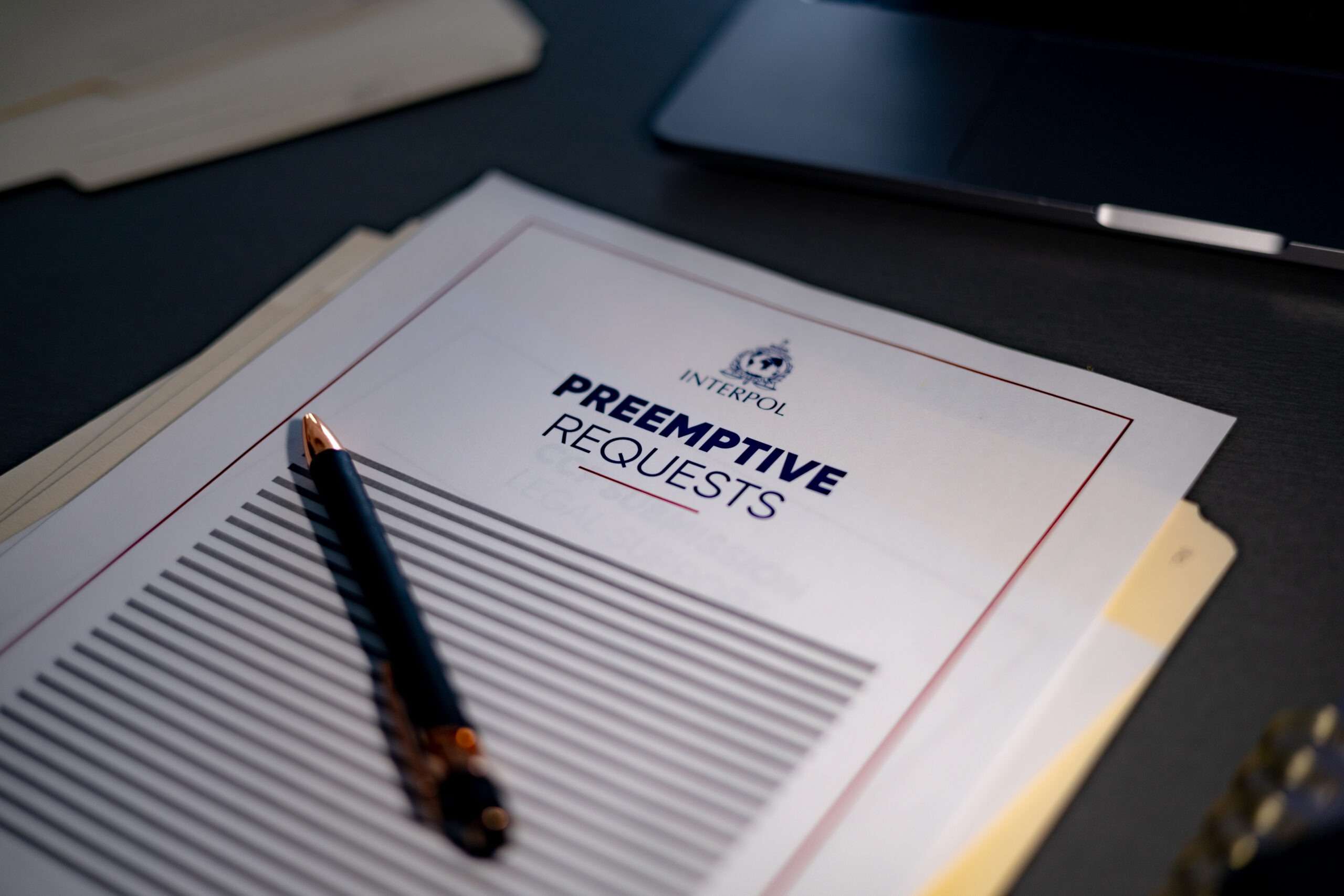
Legal Basis and Procedure of a Preemptive Request
While the CCF Statute does not expressly mention 'preemptive requests', the practice is recognised within INTERPOL's system.
A preemptive request asks INTERPOL to flag or block any future data submission concerning an individual, even when no information currently exists in its files, on the basis that processing such data would breach INTERPOL's Constitution and the Rules on the Processing of Data (RPD).
Upon receipt, the CCF transmits the request to INTERPOL's General Secretariat, which records the information and may take it into account during its pre-publication compliance review.
Since 2016, Red Notice requests have been subject to internal review before publication to assess compliance with INTERPOL rules, including neutrality, proportionality, and human rights.
What a Preemptive Request Does Not Do
A preemptive request does not trigger a formal review or decision by the CCF. The CCF's role is to transmit the submission to INTERPOL's General Secretariat, which may refer to it later. Applicants should be aware of the following limitations.
No Decision or Legal Assessment
The CCF will not issue a determination on whether a future Red Notice would comply with INTERPOL's rules. No findings on legality or compliance are made.
No Confirmation of Ongoing Monitoring
After submission, the applicant typically receives a brief acknowledgment only. There is no continuing monitoring or confirmation that the request remains under review.
No Automatic Notification
A preemptive request does not guarantee notification if INTERPOL later processes data or publishes a Red Notice. New data may still be entered without warning.
No Guarantee of Refusal
A preemptive request may influence internal assessment, but it does not ensure a refusal. Decisions remain with the General Secretariat and its review mechanisms, including the Notices and Diffusions Task Force, when assessing publication and compliance.
When a Preemptive Request Makes Sense
The tool is useful when the risk of a non-compliant notice is concrete, documentable, and time-bounded. Three recurring profiles, plus any other credible misuse scenario.
Political Dissidents and Activists
Journalists, opposition figures, and civil-society actors whose home state is expected to open a criminal file in connection with protected expression, association, or political activity. The preemptive filing puts the Article 3 predominance analysis on record before any notice request is submitted.
Executives in Jurisdictional Disputes
Company directors and shareholders facing criminal complaints that arise out of commercial disputes, contested corporate transactions, or regulatory turf wars. The filing frames the underlying dispute as civil or administrative in nature and surfaces the double-criminality and fair-trial concerns early.
Asylum Seekers Anticipating Retaliation
Individuals who have filed, or are preparing to file, an asylum claim in a safe country and who anticipate that their country of origin will seek a Red Notice in response. The preemptive filing documents the protected status and the risk of persecution before any publication request is entertained.
Any Other Credible Misuse Scenario
The profiles above cover the recurring cases, not the full range. A preemptive filing fits anyone with documented reason to believe that a state will seek to instrumentalise INTERPOL channels against them: dual nationals weighing a return after a change of regime, witnesses or whistle-blowers in transnational investigations, targets of a collapsing extradition file, or any individual whose public record already signals that a foreign authority intends to reach them abroad. What matters is that the risk is concrete, time-bounded, and evidenced on paper.
How We Prepare a Preemptive Request
The way a preemptive request is structured determines whether it will be meaningfully noted by INTERPOL's General Secretariat during future compliance reviews. Four steps, consistently applied.
Risk Assessment
We analyse the background of the case to identify indicators of an abusive request: political motivation, due process concerns, or disproportionate measures at the national level. The assessment frames what the submission has to show.
Drafting the Preemptive Request
We prepare a written submission explaining why future processing would breach INTERPOL's Constitution or the RPD. The CCF has not set specific format rules for preemptive requests, but we apply the discipline expected of a CCF deletion request: a ten-page argument, up to twenty appendices, every assertion sourced and indexed.
Transmission to the General Secretariat
The CCF Secretariat transmits the request to the General Secretariat, which records it for possible reference if a publication request is later made. No further feedback is usually provided beyond confirmation of transmission.
Follow-Up
We monitor developments that may lead to a future Red Notice and prepare documentation to respond quickly if one is issued, including readiness for a CCF deletion request where appropriate.
Why Choose Otherside for Preemptive Requests
Otherside is a boutique INTERPOL-only law firm based in Marseille, France. Preemptive filings handled directly by a former CCF Legal Officer with six years inside the Commission, on a transparent fee structure.
Six Years Inside the CCF
Founder served as Legal Officer at the Commission for six years. The practice is built on first-hand experience of how preemptive submissions are read and recorded by the Secretariat.
About the founderExtensive Preemptive Filings
Preemptive requests drafted across politically sensitive jurisdictions, commercial disputes reframed as criminal matters, and other high-risk profiles. Each filing informs the next.
See case resultsContinuity If a Notice Issues
If the preemptive filing does not prevent publication, the submission feeds directly into the deletion request and, where warranted, a temporary blocking application. Continuity without handover.
Red Notice removalTransparent Fees
Free 30-minute consultation where the file falls within scope. Pure fixed fee for preemptive requests, agreed upfront. No success component on this procedure.
View fee structureConsidering a preemptive request?
Where there is reason to anticipate a politically motivated or unfounded Red Notice request, a preemptive filing puts documented compliance concerns on INTERPOL's file before any publication. A free 30-minute Zoom consultation is offered where the firm's criteria for representation are met.
Questions on Preemptive Requests
What is a preemptive request?
A preemptive request is a written submission asking INTERPOL not to process, in the future, data concerning a named individual, on the ground that such processing would contravene INTERPOL's Constitution and its Rules on the Processing of Data. The CCF Statute does not expressly provide for the instrument, but the practice is recognised within INTERPOL. On receipt, the CCF transmits the request to the General Secretariat, which records it and may rely on it during the compliance screening that precedes any future publication.
Does the CCF take a decision on a preemptive request?
No. The CCF does not carry out a formal examination and does not rule on whether a future Red Notice would be compliant. Its role is confined to transmitting the request to the General Secretariat, which is the body competent to assess conformity at the publication stage through its internal review mechanisms, including the Notices and Diffusions Task Force.
How long does a preemptive request stay on file?
The General Secretariat retains the submission within INTERPOL's information system so that it can be consulted during any future compliance review concerning the individual. There is no published shelf life, and the usefulness of the request tends to correlate with the strength and topicality of the evidence it documents. Where circumstances evolve materially, a supplemental filing keeps the record current.
Will I be notified if INTERPOL later receives a request to publish a Red Notice concerning me?
No. Filing a preemptive request does not create a notification channel. INTERPOL does not inform the subject of subsequent processing or publication. Where there are grounds to suspect that data has been recorded, confirmation runs through a separate data access request filed with the CCF.
Is there a fee for filing a preemptive request?
No. INTERPOL does not charge applicants to file or process a preemptive request. Costs arise only where the applicant chooses to be represented by counsel.
Does a preemptive request guarantee that no Red Notice will be published?
No. The decision whether to publish a Red Notice rests with the General Secretariat's internal compliance mechanisms. A preemptive request can weigh on that assessment, in particular where it sets out clear indicators of political motivation, disproportionate prosecution, or breach of the Rules on the Processing of Data, but it cannot bind the outcome.
What happens if a Red Notice is published despite the preemptive request?
The preemptive filing continues to serve a purpose. Its arguments and evidence feed directly into a request for deletion before the CCF, and, where the circumstances call for it, into a temporary blocking application under Article 37 of the CCF Statute. The work is not lost; it is redeployed on a shorter timeline.