

Free tools

Two assets, open to everyone.

A queryable database of published CCF jurisprudence, and a free self-service tool that identifies the legal grounds for INTERPOL data removal that may plausibly be raised in your case. Both are independent of any engagement with the firm.

An Otherside resource

The CCF Decisions Database.

A curated repository of published CCF jurisprudence, indexed by topic, notice type, and legal ground. Designed for practitioners and applicants who need to understand how the Commission reasons in practice.

65+
Published decisions
9
Years indexed
4
Notice types
Open the database Free · No registration
New · Free tool

The INTERPOL Removal Grounds Tool.

A free self-assessment that identifies the legal grounds for INTERPOL data removal that may plausibly be raised in your case. Built on the seventeen grounds derived from INTERPOL's legal framework and sixty-five published CCF decisions. A written report is delivered to your inbox.

3
Minutes to complete
17
Removal grounds screened
65
CCF decisions indexed
Run the assessment Free · No account
Legal framework

INTERPOL's legal framework.

INTERPOL operates across 196 member countries under a defined set of rules, supervised by an independent commission. Two foundations matter: the constitutional and procedural rules that govern INTERPOL's activities, and the body that supervises its data processing. The same framework also defines the corrective route when the rules are not followed in practice, which the next section describes.

01 The legal framework

INTERPOL's Constitution and the Rules on the Processing of Data.

The Constitution sets out INTERPOL's mandate, structure, and core principles, including political neutrality and the prohibition on activities of a political, military, religious, or racial character.

The Rules on the Processing of Data (RPD) govern how personal data and notices, including Red Notices, are recorded, reviewed, circulated, and retained within INTERPOL's information systems. The RPD sets requirements for accuracy, relevance, and data quality.

02 The supervisory body

The Commission for the Control of INTERPOL's Files (CCF).

The CCF is an independent body responsible for ensuring that INTERPOL's processing of personal data complies with applicable INTERPOL rules. It handles requests to access, correct, or delete data recorded in INTERPOL's files.

Its mandate, powers, and procedure are set out in the CCF Statute. The Commission is organised into two chambers: a Supervisory and Advisory Chamber and a Requests Chamber that decides individual cases, including applications for revision.

Legal framework, continued

When the framework is misused.

The same legal framework that governs INTERPOL is also what gets violated when notices are used for purposes the rules prohibit. Three points matter: what misuse typically looks like, what its human impact is, and how the framework itself provides the remedy.

Otherside INTERPOL law firm — misuse of INTERPOL channels and its impact on individuals
Image · Otherside
Political cases

Notices used for political aims.

Some member countries use Red Notices and diffusions for political aims rather than legitimate criminal justice purposes. This misuse often targets political opponents, dissidents, activists, and journalists, internationalising domestic political disputes in direct violation of Article 3 of INTERPOL's Constitution, which forbids any intervention of a political, military, religious, or racial character.

Impact

Impact on human rights.

Individuals affected by misuse may face arbitrary detention, restrictions on freedom of movement, and damage to reputation, with consequences for fair trial guarantees and the presumption of innocence. Where there is a credible risk of torture or inhumane treatment in the requesting jurisdiction, Article 2 of INTERPOL's Constitution and the human rights protections of the Universal Declaration of Human Rights are directly engaged.

Remedy

Addressing misuse before the CCF.

The CCF provides the procedural route for challenging non-compliant data. The Commission has the authority to order deletion of Red Notices, diffusions, and other data that fail to comply with INTERPOL's rules. For representation before the Commission, see our INTERPOL legal services.

Public record

Otherside on INTERPOL misuse, in public.

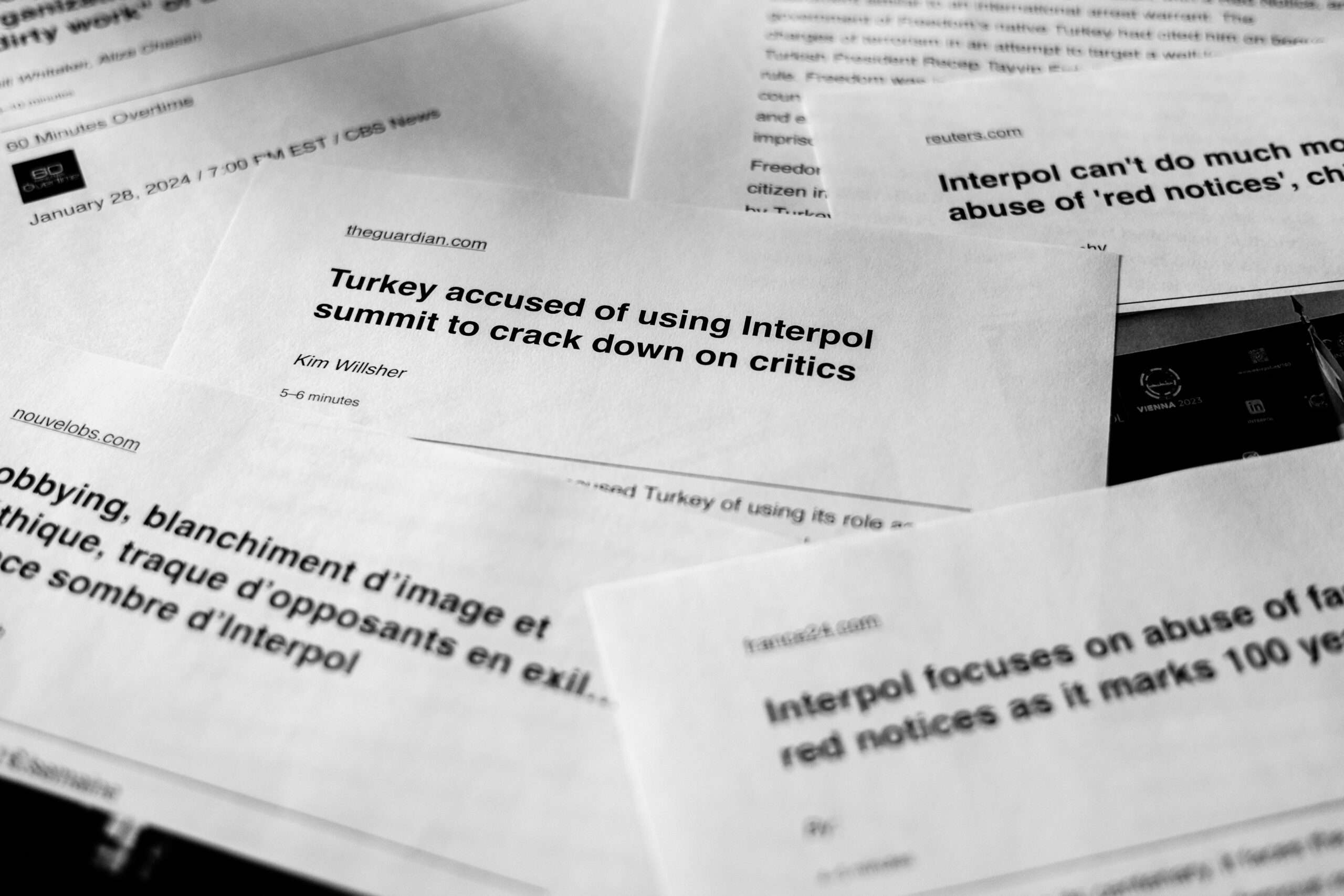
The work on misuse is not just internal. Otherside has been invited to brief a U.S. Government commission on authoritarian abuse of INTERPOL, and the firm's analysis has been cited in international investigations and long-form documentaries on the same subject.

Public testimony 29 October 2024

Countering Authoritarian Abuse of INTERPOL.

U.S. Helsinki Commission — Commission on Security and Cooperation in Europe, an independent U.S. Government agency advancing human rights and the rule of law across the OSCE region.

Charlie Magri was invited to testify at a public briefing examining how authoritarian states continue to exploit INTERPOL's channels to target dissidents, journalists, and political opponents abroad. The testimony assessed the impact of INTERPOL's recent reforms (the Notices & Diffusions Task Force, the Refugee Policy, and the expanded powers and statutory timeframes granted to the CCF) and proposed three priority reforms.

Three priority reforms
  1. 01 Stronger training and oversight of National Central Bureaus.
  2. 02 Granular country-level transparency in INTERPOL's reporting on Red Notice and Diffusion requests, cancellations, and rejections.
  3. 03 Additional resources for the CCF to keep pace with case volume and to publish anonymised decisions with full legal reasoning.
Charlie Magri · U.S. Helsinki Commission · Washington D.C.

See all press coverage · Read about the founder

Next step

Facing an actual INTERPOL notice? Discuss your case with Otherside.

The toolkit is the public-facing side of the practice. If your situation falls within scope, a free 30-minute Zoom consultation is offered. Fee discussion follows only if the firm confirms it can assist.