

INTERPOL Revision Request
Our Services: INTERPOL Revision Requests
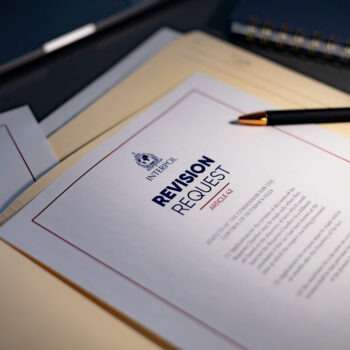
A revision request allows an individual to ask the Commission for the Control of INTERPOL’s Files (CCF) to reconsider a previous decision when new information has emerged.
This procedure under Article 42 of the CCF Statute is exceptional. It applies only where a new fact could have led the CCF to reach a different conclusion in its earlier review.
At Otherside, we assist clients in preparing and submitting INTERPOL revision requests that meet the CCF’s strict admissibility and procedural requirements.
Legal Framework Applicable to INTERPOL Revision Requests
A revision request before the CCF is the only procedure that allows a person to seek re-examination of a previous CCF decision. It is governed by Article 42 of the CCF Statute, which sets strict admissibility conditions for any INTERPOL revision request.
A request is admissible only when all three requirements are met:
(i) It is based on the discovery of a new fact;
(ii) That fact could have led the CCF to a different conclusion had it been known during the original examination; and
(iii) The request is submitted within six months of discovering the new fact.
A revision request is not an appeal. It is a limited procedural remedy designed to safeguard fairness while maintaining the finality of CCF decisions.
When a Revision Request May Be Filed
A revision request may be filed only when new information arises after the Commission’s decision and meets the Article 42 criteria. The main circumstances that may justify submitting an INTERPOL revision request include:
01
Discovery of a New Fact
The request must be based on a new fact that existed at the time of the original review but was unknown to the applicant.
It must be significant enough that, if presented earlier, the CCF might have reached a different conclusion.
02
Material Impact on the Original Decision
The new element must be capable of changing the outcome of the previous proceedings.
Evidence that simply reinforces arguments already examined by the CCF will usually not meet this requirement.
03
Compliance with the Six-Month Time Limit
Under Article 42(2), the application must be submitted within six months from the date the new fact was discovered.
The Commission applies this time limit strictly.
04
Exceptional Nature of the Remedy
A revision request is not a second review and not an appeal.
It is a narrow mechanism reserved for exceptional cases where a new fact materially alters the basis of the prior decision.
Our Approach
At Otherside, we manage each INTERPOL revision request under Article 42 to ensure it meets the CCF’s admissibility standards and is presented in the clearest procedural form.
Assessment of the New Fact
Preparation of the Revision Request
Submission to the CCF
Review and Follow-Up
Why Choose Otherside
At Otherside, we act exclusively before the CCF. Our work on Article 42 revision requests reflects an understanding of how the Commission defines a new fact, applies admissibility criteria, and treats the six-month deadline.
Exclusive focus on CCF proceedings
Experience with Article 42 Applications
Analytical Precision
Continuity and Follow-Up
Contact an INTERPOL Lawyer for Revision Requests
If you have received a CCF decision and have since discovered new information that may affect its reasoning, you may be eligible to submit an INTERPOL revision request under Article 42 of the CCF Statute. We assist clients in assessing admissibility, preparing supporting documentation, and presenting the request before the CCF in strict confidence.