

The Commission for the Control of INTERPOL’s Files (CCF) has published its Annual Activity Report for 2024. As in previous years, the report provides a detailed overview of the Commission’s work, with a particular focus on the processing of individual requests, including access requests, deletion requests, and applications for revision.
The 2024 report is notable for the scale of activity recorded. Several figures reach historic highs and confirm that the CCF is operating in an environment of sustained pressure. At the same time, the report offers valuable insight into compliance outcomes, cooperation by National Central Bureaus (NCBs), and the structural limits affecting the effectiveness of the individual remedy within INTERPOL.
Volume of Requests and Recent Trends
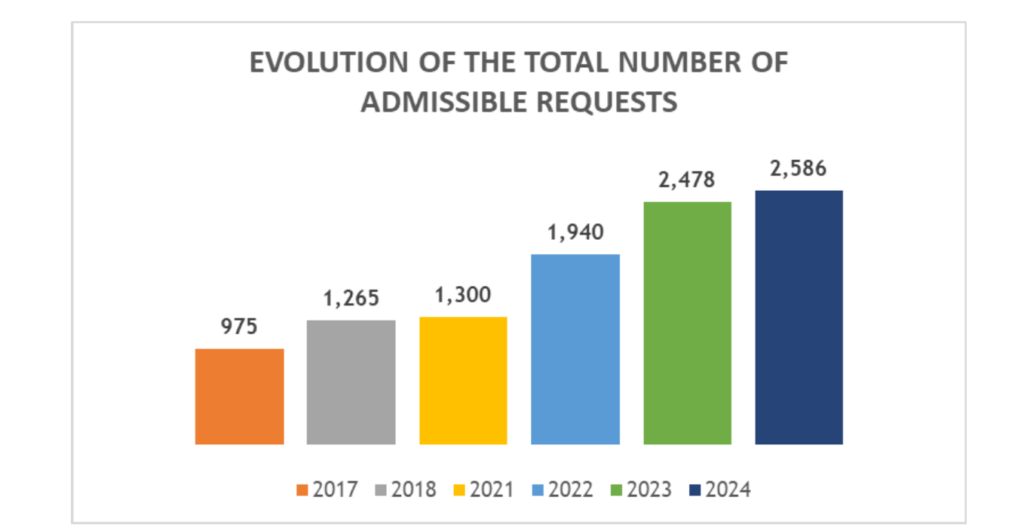
The Executive Summary of the report places the processing of requests at the center of the CCF’s activity. In 2024, the Commission recorded the highest number of admissible requests ever received.
“In 2024, the CCF received 2,586 new admissible requests, which includes admissible access requests, deletion requests, or applications for revision, the highest number ever received.”
The CCF explicitly links this sustained workload to broader developments in international law enforcement and data governance.
“The volume of the CCF’s activity in 2024 reflects the overall increased scope of personal data processing for law enforcement purposes globally, as well as the increasing attention focused on international cooperation and data-protection standards.”
Although the total number of requests continued to rise compared to 2023, the rate of increase slowed to approximately four per cent. This suggests a relative stabilization following several years of sharp growth, rather than a further acceleration in demand.
Types of Requests and Prevalence of Deletion Proceedings
The report provides a breakdown of admissible requests received in 2024, confirming the central role of deletion requests in the CCF’s work.
“Of the new admissible requests, approximately 37 per cent were access requests, 45 per cent were deletion requests, and 18 per cent were applications for revision.”
Deletion requests thus remained the most significant category, both in volume and in terms of their legal consequences for individuals subject to data processed in INTERPOL’s files.
Outcomes of Deletion Requests and Compliance Trends
The most instructive part of the report concerns the outcome of deletion requests. Out of 1,077 closed deletion requests, 703 were admissible cases involving applicants subject to data in INTERPOL’s systems.
A substantial number of cases were resolved before the CCF issued a formal decision.
“164 requests resulted in data deleted by the NCBs source or by the General Secretariat prior to a CCF decision.”
For the remaining 539 deletion requests decided by the CCF on the merits, the outcomes were as follows:
“In 217 requests, the CCF found the data to be compliant with rules.”
“In 272 requests, the CCF found the data to be not compliant with rules.”
“In 50 requests, data were found non-compliant for the reason of a total lack of cooperation from the NCB source.”
The report summarizes these figures with a key statistic.
“Overall, for the 539 deletion requests decided by the CCF, the level of compliance was 40 per cent.”
The report also notes a shift in compliance outcomes compared to previous years.
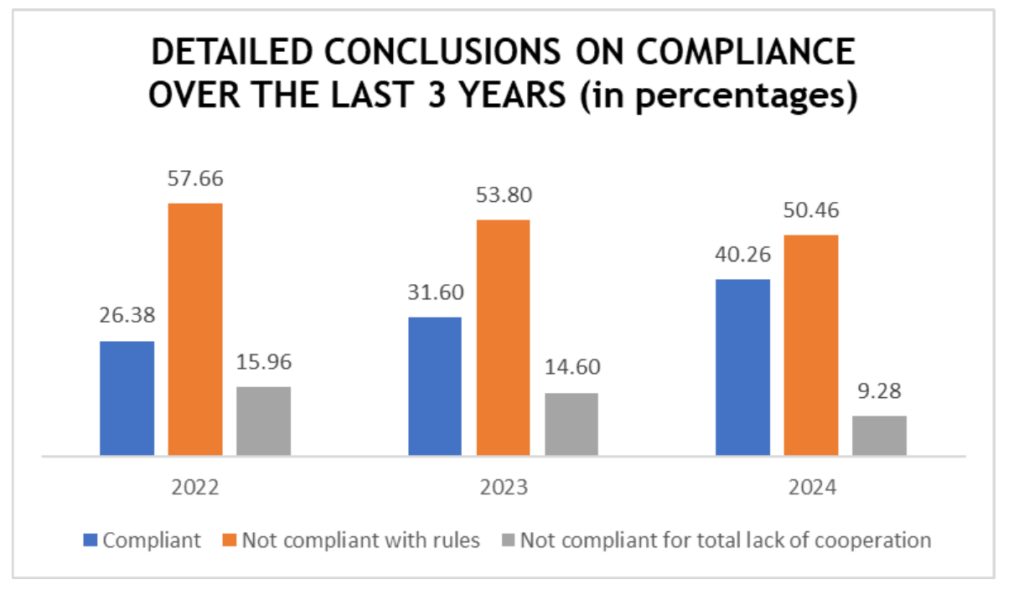
“The percentage of compliant cases was higher than in recent years, while the percentage of cases deemed non-compliant based on a total lack of cooperation from the NCBs was less than in recent years.”
Viewed over a three-year period, the compliance rate has increased steadily, rising from approximately 26 per cent in 2022 to just over 31 per cent in 2023 and reaching around 40 per cent in 2024, while non-compliance based on a total lack of cooperation has declined in parallel.
This increase in compliance findings over time was addressed by the CCF Chairperson, Teresa McHenry, who linked this evolution in part to changes in the level of cooperation by National Central Bureaus, in her address to the INTERPOL General Assembly (93rd Session, Marrakech, 24–27 November 2025).
“You may notice that both in 2023, and in 2024, there has been an increase in the number of cases found compliant. That is in part due to a decrease in the number of cases where the data were found non-compliant because the NCB didn’t respond at all to CCF inquiries.”
Speech of the CCF Chairperson, Teresa McHenry, to the INTERPOL General Assembly (93rd Session, Marrakech, 24–27 November 2025)
The CCF Chairperson also commented on the broader significance of these developments for cooperation within INTERPOL.
“We believe it is a good thing for INTERPOL that we are having fewer instances of NCBs not responding at all to CCF inquiries. We know that your NCBs are often pressed and dealing with limited resources themselves and we appreciate their work. In seeing NCB responses to the CCF inquiries over time, it appears to us that NCBs now have a better understanding of what the CCF does and doesn’t do. That may also be part of why the compliance rate has improved.”
Speech of the CCF Chairperson, Teresa McHenry, to the INTERPOL General Assembly (93rd Session, Marrakech, 24–27 November 2025)
Processing Times and Operational Constraints
Despite record productivity, the CCF continues to face significant challenges in meeting statutory deadlines. The report provides detailed figures on processing times.
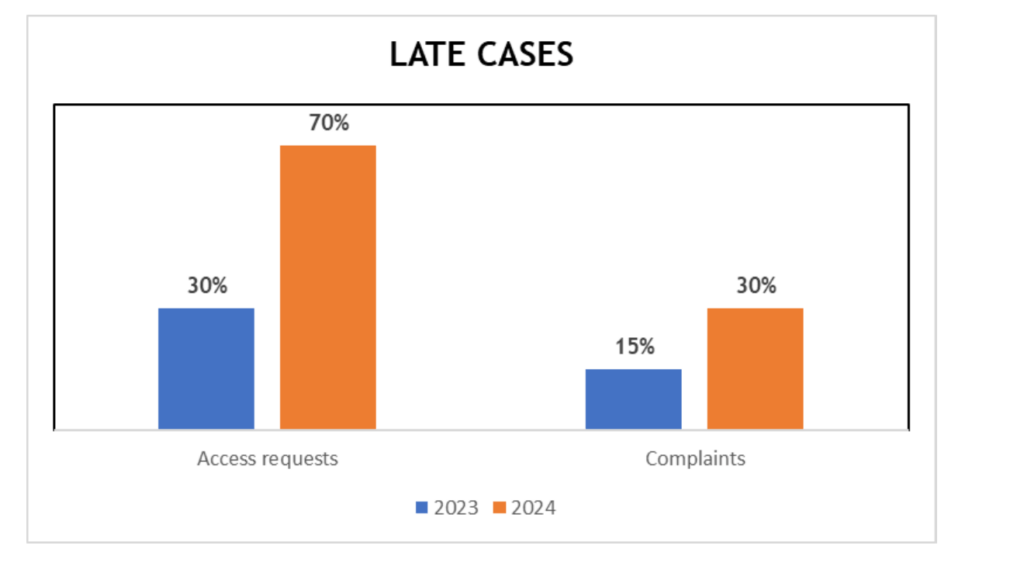
“In 2024, 30 per cent of access requests were finalized within four months and 70 per cent were not.”
“For deletion requests, 70 per cent were completed within nine months, and 30 per cent were not.”
The reasons for these delays are described in detail and include sustained growth in requests, limited resources, delayed responses from the General Secretariat and NCBs, increasing complexity of cases, and extensive exchanges concerning disclosure restrictions.
The operational burden is illustrated by a striking figure.
“In a year, the CCF received more than 82,000 e-mails.”
These figures confirm that delays remain a structural issue, even as the CCF continues to close a record number of requests.
The delays identified in the 2024 Annual Activity Report were directly addressed by the CCF Chairperson in her speech to the General Assembly, where she set out the Commission’s assessment of the situation for 2025 and 2026.
She began by reaffirming that the management of workload and delays would remain a central priority for the Commission in the coming years.
“With respect to the CCF’s work in 2025 and moving forward into 2026, among the highest priorities will be to continue to address the workload and associated delay issues.”
Speech of the CCF Chairperson, Teresa McHenry, to the INTERPOL General Assembly (93rd Session, Marrakech, 24–27 November 2025)
She then provided a candid assessment of the short-term outlook, explicitly acknowledging that delays were expected to worsen in 2025, notwithstanding ongoing efforts to address them. This assessment was linked both to the continued increase in the number of cases and to the time and resources required to implement structural solutions.
“Unfortunately, I believe that in 2025, our numbers will be even worse in terms of delays in resolving cases, for a variety of reasons including an increase in the number of cases and the time and resources needed to hire new staff and develop new tools.”
Speech of the CCF Chairperson, Teresa McHenry, to the INTERPOL General Assembly (93rd Session, Marrakech, 24–27 November 2025)
Finally, the Chairperson referred to measures already taken and to the anticipated effects of those measures over a longer timeframe. In particular, she pointed to recent recruitments and the development of new technological tools as factors expected to improve processing times once fully operational.
“As I said before, however, we just got some new staff on board and hope soon to have some new IT tools starting to be operational early next year, so we hope and expect that the 2026 numbers will start showing improvement.”
Speech of the CCF Chairperson, Teresa McHenry, to the INTERPOL General Assembly (93rd Session, Marrakech, 24–27 November 2025)
Statute Review and the Practical Meaning of CCF Independence
The report also addresses institutional developments, including the ongoing review of the CCF Statute. While there is broad agreement on the importance of preserving the CCF’s independence, the report acknowledges that this principle can raise complex questions in practice.
“Everyone has agreed that changes to the Statute should not threaten the CCF’s independence, although everyone has not always been in agreement concerning what that means in practice.”
The same tension between shared objectives and practical implementation was explicitly addressed by the CCF Chairperson in her speech to the General Assembly, in the context of the review process conducted under the authority of the Committee on the Processing of Data (CPD).
She first emphasized that there was general agreement on the overarching goals of the review, namely improving the Statute while safeguarding the CCF’s independence and its role as an effective remedy within INTERPOL.
“As I mentioned last year when discussing the review process, I believe everyone agrees with the overall goals to improve the Statute without compromising the CCF independence and its ability to serve as an effective remedy for INTERPOL and ensure INTERPOL’s commitment to preventing abuse.”
Speech of the CCF Chairperson, Teresa McHenry, to the INTERPOL General Assembly (93rd Session, Marrakech, 24–27 November 2025)
She then underlined that, despite this consensus at the level of principle, significant divergences may arise when those principles are applied in practice, particularly with respect to the scope of independence and the CCF’s relations with other INTERPOL stakeholders.
“In practice, however, these are hard issues and there may not always be agreement including regarding what independence means in practice, for instance regarding information sharing or relations with stakeholders including the General Secretariat, NCBs and Applicants.”
Speech of the CCF Chairperson, Teresa McHenry, to the INTERPOL General Assembly (93rd Session, Marrakech, 24–27 November 2025)
Looking ahead, the CCF identifies two main priorities: addressing delays and engaging constructively in the Statute review process.
“One of the CCF’s highest priorities moving forward will be continuing to address the delay problem in processing requests, including through integration of new staff and new technology tools.”
“The CCF will strive to ensure that the CCF remains independent, impartial, productive, and an effective remedy for applicants and for INTERPOL.”
Conclusion
The 2024 Annual Activity Report confirms a continued increase in the number of admissible requests submitted to the CCF, reaching the highest level recorded to date. At the same time, the rate of increase compared to previous years remains limited, suggesting a relative stabilization in the volume of requests after several years of sustained growth. This trend points to a consolidation of the CCF’s role as a permanent and well-established mechanism for individual review within INTERPOL, rather than to an accelerating expansion.
The compliance data over the last three years indicate a gradual but clear shift in the CCF’s findings. The proportion of cases in which the CCF finds data to be compliant with INTERPOL’s rules has steadily increased, while the proportion of cases found non-compliant has correspondingly decreased. In parallel, findings of non-compliance based on a total lack of cooperation from National Central Bureaus have declined significantly.
Against this background, the challenges identified in the report are primarily structural. Delays in the processing of requests continue to affect a substantial share of cases and remain a central concern for applicants and practitioners. At the same time, the ongoing review of the CCF Statute introduces an additional layer of complexity, as efforts to improve efficiency and governance must be carefully balanced against the need to preserve the CCF’s independence and its role as an effective individual remedy. The coming period is therefore likely to be shaped less by further increases in caseload and more by the CCF’s ability to manage delays and institutional reform while maintaining the credibility of its review function.